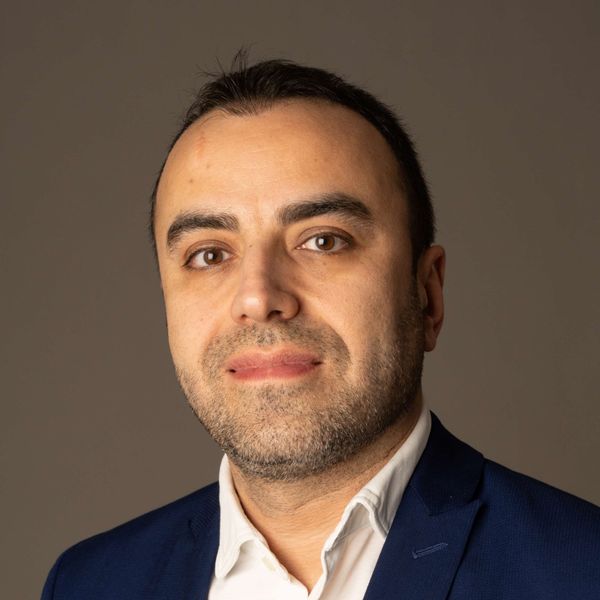
 Arash Ajoudani
KEYNOTE LECTURE
Wearables, Surroundables, and AI for Next-Generation Healthcare, Sports, and Robotics
Arash Ajoudani
Fondazione Istituto Italiano di Tecnologia, Italy
ABSTRACT
Wearables, ranging from physiological sensors to smart textiles and lightweight exoskeletons, provide continuous, high-resolution insight into individual states such as fatigue, stress, movement quality, and cognitive load. In parallel, surroundables, i.e., ambient sensing ecosystems built from cameras, LiDAR, mmWave, UWB, and intelligent environments, offer contextual, multi-person, and task-aware monitoring without the need for instrumentation on the body. Individually, each class of technology offers powerful but partial perspectives: wearables provide intimate, personalized data; surroundables provide scalable, non-invasive situational awareness. When integrated, however, they create a unified human-centric perception pipeline capable of robust, multimodal estimation of physical workload, ergonomics, intent, and health risks. This fusion opens the way to adaptive assistance in healthcare, sports performance augmentation, and human–robot interaction, where robots, AI systems, and clinical tools can dynamically adjust their behavior based on a holistic understanding of human states. This talk will explore how each or combination of these two technological ecosystems can unlock a new generation of responsive, intelligent, and safe human-centered applications, from proactive clinical monitoring and rehabilitation robotics to predictive fatigue management in sports and next-generation assistive AI.
SPEAKER BIOGRAPHY
Arash Ajoudani is the director of the Human-Robot Interfaces and Interaction (HRI²) laboratory at IIT. He is a recipient of the European Research Council (ERC) grants Real-Move (ERC POC 2023) and Ergo-Lean (ERC STG 2019), the coordinator of the Horizon-2020 project SOPHIA, the co-coordinator of the Horizon-2020 project CONCERT, and a principal investigator of the Horizon Europe project Tornado, HORIZON-MSCA project RAICAM, and the national projects LABORIUS, COROMAN, and ReFinger. He is a recipient of the IEEE Robotics and Automation Society (RAS) Early Career Award 2021, and winner of the MECSPE Robotics and AI Awards 2025, SmartCup Liguria award 2023, Amazon Research Awards 2019, of the Solution Award 2019 (MECSPE2019), of the KUKA Innovation Award 2018, of the WeRob best poster award 2018, and of the best student paper award at ROBIO 2013. His PhD thesis was a finalist for the Georges Giralt PhD award 2015 - best European PhD thesis in robotics. He was also a finalist for the best paper award on human-robot interaction at ICRA2024, the best paper award mobile manipulation at IROS 2022, the best paper award at Humanoids 2022 (oral category), the Solution Award 2020 (MECSPE2020), the best conference paper award at Humanoids 2018, the best interactive paper award at Humanoids 2016, the best oral presentation award at Automatica (SIDRA) 2014, and for the best manipulation paper award at ICRA 2012. He is the IIT principal investigator of s the Robotics for Manufacturing (R4M) joint lab of the Leonardo labs, and of the IIT-Intellimech JOiiNT lab. He is the author of the book "Transferring Human Impedance Regulation Skills to Robots" in the Springer Tracts in Advanced Robotics (STAR), and several publications in journals, international conferences, and book chapters. He is currently serving as an elected IEEE RAS AdCom member (Class 2024 and Class 2027) and as a Senior Editor of the International Journal of Robotics Research (IJRR). He has been serving as a member of scientific advisory committee and as an associate editor for several international journals and conferences such as IEEE RAL, ICRA, IROS, ICORR, etc. He is a scholar of the European Lab for Learning and Intelligent Systems (ELLIS). His main research interests are in physical human-robot interaction, mobile manipulation, robust and adaptive control, assistive robotics, and tele-robotics.